Cultivating the Feminine Genius While Young
By Caitlyn Van Horssen. This letter first appeared in Issue 3: Summer 2026 under the title, “Letters to Young Women, Letter 2: Anna and Kitty”
“Levin and Kitty were particularly happy and conscious of their love that evening. And their happiness in their love seemed to imply a disagreeable slur on those who would have liked to feel the same and could not—and they felt a prick of conscience. "
Anna Karenina, Leo Tolstoy
An Epic Summer Read
Last summer I finished what has become one of my favorite novels, Anna Karenina, by Leo Tolstoy. I highly recommend this book and would suggest reading it several times throughout your life. If you’ve never read the book, you may be familiar with one of the movie renditions. Regardless, if you are new to this story, or have some preconceived notions, I’d like to offer a short summary and describe some of the cultural commentary that Tolstoy weaves throughout the novel. The story is about a woman named Anna who commits adultery and becomes the mistress of a charming count and military man in Russia. The movie renditions at times romanticize the sin that Anna and Count Vronsky commit and there is much opportunity for introspection that is lost. In the book, Anna’s actions aren’t romanticized. In fact, you might even feel detached and cool towards her character in the end. Even though the book is named “Anna Karenina,” the novel isn’t overly focused on her personal story and failings, but is meant to be a metaphor of Russian society at the time. The minds and hearts forming Russian culture are invited to pause and examine whether or not Anna’s path is one that they want to parallel. Through Anna’s character, Tolstoy powerfully illustrates what may happen if popularized philosophical beliefs about nihilism continue to sweep through Russia. Nihilimism, a philosophy that rejects moral principles and religious belief, steamrolled a cultural movement within Russian culture that replaced traditional values like duty to one’s family, religion, and morality, with materialism, intellectualism, and socialism. These themes that play out in the novel are not just evident within the life of one character. Each character is wrestling with the same aspects of what Russian society as a whole is grappling with: vice versus virtue, secularism versus traditionalism, nihilism versus meaning, superficial status versus commonplace duty. As a reader, there are many occasions to pause and ask: what paths lead to a beautiful life? How are humans designed to thrive? At the heart of our endeavor in this article, how is the woman designed to flourish?
“Further up and Further in”
To answer these questions, we can drift a little more into Tolstoy’s novel. Anna isn’t a true Nihilist, but rather represents Nihilistic outcomes. Anna’s downfall can be more readily analyzed as hedonism. Fundamentally, hedonism is the drive to seek pleasure and avoid pain. And while a Nihilist can’t be automatically considered a hedonist, it isn’t hard to see why it would be easy to attach the two philosophies. If there is no meaning, no higher moral principle or need for virtue, why wouldn’t I seek that which I find to be most pleasurable? Both of these philosophies permeate modern secular culture. We may use different phraseology, but likely you don’t have to look far to see the impact on society. Anna’s tragic social experiment, living for herself and the next pleasure despite having responsibilities and duties she should consider, does not end well. She loses herself and makes a choice she would have thought herself incapable of: she abandons her one truly meaningful and deeply satisfying love, a son whom she birthed within her marriage to her husband, Alexei. Anna’s devastating choices turn her in upon herself and drive her mad, resulting in her suicide. For Tolstoy, it isn’t about one woman’s life getting derailed. He demonstrates that the pillars of a healthy, beautiful, and meaningful society have the potential to give way.
An Antithetical Femininity
When I finished the book, several things stuck out to me. First, I thought that Anna allegorically represents the antithesis of what is referred to as the feminine genius. It is a term coined by Saint John Paul the II in his Letter to Women in 1995. It refers specifically to the gifts inherent within each woman. The term “feminine genius” allows us to elaborate on the essence of what it means to be a woman and how women may live out these gifts regardless of the many ways they may also live out their primary and secondary vocations. While it is not easy to explicitly state what constitutes the feminine genius, in general, there are four aspects commonly mentioned: the gifts of sensitivity, receptivity, generosity, and a maternal heart. While you meditate on and consider these God-given gifts, I’d also like to invite you to meditate on both the virtues that build up a woman in the feminine genius and the various follies that can hinder abundant growth.
Anna’s character may not feel very relatable. I doubt many readers would consider themselves a hedonist in the literal sense of the word. However, I wonder if we could still learn from Anna’s sad story if we take a deeper look at our passive consumption of pleasure in the modern day. We live in an era where self-indulgence is much too easy. Anna’s primary struggles stem from being indulgent in her own matters. The more she indulges herself, the more her vision of everything and everyone in her life narrows. She says to Vronksy “All is over…I have nothing but you, remember that.” She lacks empathy, self-control, and emotional stability. Very near her tragic end, she says, “I don't know who I am, Vronksy, I only know my appetites.” Tolstoy’s Anna, as a character, is intense. But it is this intensity in the midst of realism that can stop us in our tracks and make us ask: what makes me more or less myself as a woman?
The Strength of Women
Saint John Paul II in Gaudiem et Spes explains that, “man…cannot find himself except through a sincere gift of himself.” This statement, while true for both men and women alike, takes on a special meaning in the life of women. Saint John Paul II, elaborating on this concept in Mulieris Dignitatem, says:
The moral and spiritual strength of a woman is joined to her awareness that God entrusts the human being to her in a special way. Of course, God entrusts every human being to each and every other human being. But this entrusting concerns women in a special way - precisely by reason of their femininity. (sic)
Anna represents only one feminine archetype in the novel. The story of her and Vronsky is obviously paralleled with another couple–Levin and Kitty. Kitty’s character at first comes off as naive and a little boring. Count Vronsky ends a courtship with Kitty over his attraction to Anna. It’s a blessing in disguise that he is uninterested in her. Levin, a co-protagonist in the story, loves Kitty and is at first distraught that Kitty’s affections lie elsewhere, but in time, there is a reconciliation that brings them together. They choose to get married and, despite various difficulties and challenges, they persevere in their married life and all the responsibilities that go along with it. The book does not shy away from telling the coming of age story of Kitty: she grows in wisdom and empathy, and is a sort of anchor for Levin as he wrestles with the meaning of life and his unbelief in God. In the end, their love story and Levin’s coming to belief is the living expression of what we are made for. As women, we are created to live out the gifts of the feminine genius, to oppose selfishness, and help to build a culture that allows others to become more themselves. Kitty finds herself as she is taken up with commonplace concerns and grows precisely by noticing those entrusted to her care in various seasons of her life. She first cares for the poor and sick while on a family trip meant to restore her spirit after heartbreak. She then looks outside of herself in learning how to nurture her family life and help Levin run his large country estate, and again when caring for Levin's very ill, dying, and estranged brother. If Tolstoy’s Anna can serve as an intense introspection of one’s selfishness and indulgence, Kitty’s character can prompt us as women towards a growth minded reflection on how a woman is meant to mature and exercise feminine virtues and gifts over time.
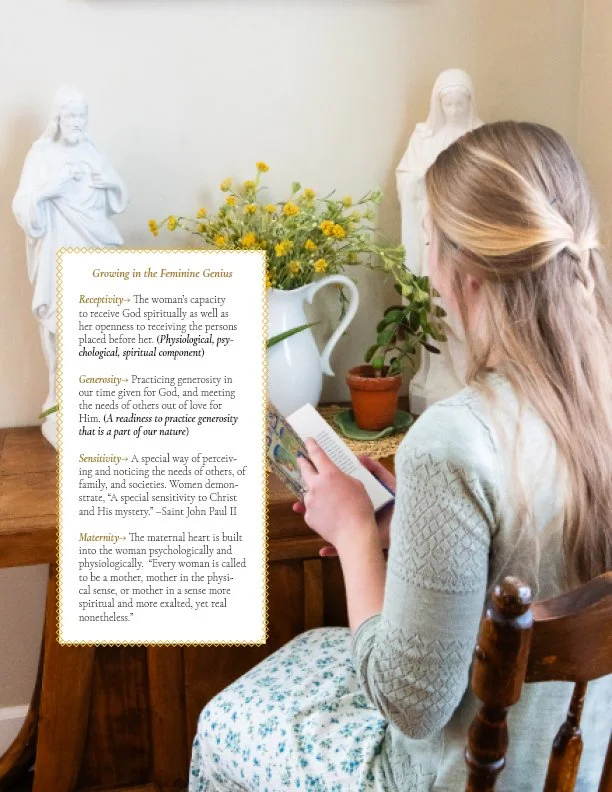
Receptivity→ The woman’s capacity to receive God spiritually as well as her openness to receiving other persons set before her. (physiological, psychological, spiritual component)
Generosity→ Practicing generosity in our time given for God and meeting the needs of others out of love for Him. (a readiness to practice generosity that is a part of our nature)
Sensitivity→ A special way of perceiving and noticing the needs of others, of family, and societies. Women demonstrate, “A special sensitivity to Christ and His mystery.” –Saint John Paul II
Maternity→ The maternal heart is built into the woman psychologically and physiologically. “Every woman is called to be a mother, mother in the physical sense, or mother in a sense more spiritual and more exalted, yet real nonetheless.”
Recollection, Conversion, and Ongoing Growth
In light of our reflections thus far, this excerpt from Saint John Paul II is worth meditating upon:
We must all set ourselves in opposition through a conversion of mind and heart, following Christ Crucified by denying our own selfishness: such a conversion cannot fail to have a beneficial and renewing influence even on the structures of society…What is needed is a continuous, permanent conversion which, while requiring an interior detachment from every evil and an adherence to good in its fullness, is brought about concretely in steps which lead us ever forward. Thus a dynamic process develops, one which advances gradually with the progressive integration of the gifts of God and the demands of His definitive and absolute love in the entire personal and social life of man. Therefore an educational growth process is necessary, in order that individual believers, families and peoples, even civilization itself, by beginning from what they have already received of the mystery of Christ, may patiently be led forward, arriving at a richer understanding and a fuller integration of this mystery in their lives” (Familiaris Consortio, Saint John Paul II).
While we are invited in all seasons to pursue this “dynamic process” by first turning our hearts and minds to God, young adulthood is especially suited to this end and purpose. This pattern and openness to ongoing conversion allows each woman to grow in knowledge of self and gradually integrate the feminine gifts in every facet of life. We can’t do this without the habit of recollection in which we meet God in silence and with humility. God speaks to us both in consolations and by “pricking our conscience.” This season of life is ripe with opportunity for looking outside of yourself and seeing who amongst you needs help, quality time, nurturing, or where your gifts could be of service. This letter is an invitation for you to examine your heart in the present time while also asking God to guide you in who you are becoming. I hope that each young woman who reads this letter may find encouragement and clarity. In each stage of life, God beckons you to practice virtue and charity. My prayer is that the arc of your story continues to develop with ever expanding insight and wisdom that will bear beautiful fruit in your life and in God’s kingdom.
